Five SaaS tools, five data silos, one frustrated developer
I started building side projects with no system. The standard advice is to subscribe to FreshBooks, HubSpot, Toggl, Asana, and Expensify. But five tools means five databases that do not talk to each other, and you become the integration layer -- re-entering client details, manually creating invoices from project milestones, context-switching between interfaces that each assume they are the center of your workflow.
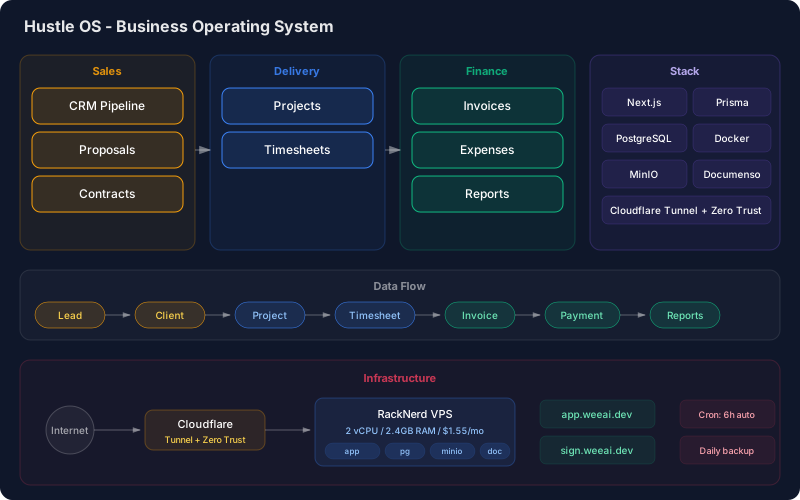
I wanted one pipeline: a lead becomes a client, a client gets a project, a project generates timesheets, timesheets flow into invoices, invoices feed financial reports. So I built it. Six days from first commit to production deployment, 189 commits, 24 database models.
One transaction turns a proposal into a billing schedule
Every module writes to the same PostgreSQL instance through Prisma. When a proposal is accepted, the system converts it into invoices in a single atomic operation -- one-time items become a single draft, milestone items become invoices spaced 30 days apart, recurring items spawn a schedule that auto-generates invoices on each cycle. Time entries logged against a project bill into an invoice where each entry becomes a line item, with the entries marked as billed and linked back.
CLI and UI Share One Core
The REST API accepts both database IDs and human-readable formats (INV-0042, PRJ-005, CTR-001). Route helpers detect the format via regex and resolve accordingly, so the API is human-friendly without sacrificing machine precision.
AI-native: an agent can run the whole system
The app was built to be operated by both humans and AI. Eight Claude Code skill files -- /invoice, /proposal, /crm, /project, /expense, /reports, /contract, /timesheet -- give an AI agent the ability to create invoices, manage the sales pipeline, log expenses, bill time entries, and run financial reports through natural language. The same CLI that a developer uses from the terminal is the same interface an AI agent uses autonomously.
AI as Operator, Not Just Assistant
The architecture made this possible. A single Next.js monolith handles SSR, API routes, PDF generation, and email sending. No microservices, no API gateway, no message queue. Every piece of state lives in one database, every deployment is one docker compose up -d. Contracts integrate with Documenso for e-signing, emails are AI-drafted with full client context, and the entire stack runs live at app.weeai.dev on a $1.55/month VPS behind Cloudflare Tunnel.
What I Learned
The app works, but I am still building more than using it. That honesty matters more than a polished story.
What surprised me: the highest-leverage output was not the software -- it was the clarity about how real-world systems connect. Building a profitability report forced me to think about which clients are worth pursuing. Building a CRM pipeline forced me to define a sales process I had never formalized. The code was the byproduct; the thinking was the product.
What I would do differently: start with fewer modules and use each one in production before building the next. I built eight modules in six days because the architecture made it easy, but depth of use reveals requirements that breadth of features misses.
What stuck with me: for a solo operator, "do not build what you can buy" is not always right. When no single SaaS connects your full workflow end-to-end, building your own is not over-engineering. It is the only way to get the integration right.
Share this project
Related Blog Posts
I Built My Own Full-Stack OS Because No SaaS Could Connect My Entire Workflow
10 min read
I Deployed My Full-Stack App on a $18.66/Year VPS. Here Is Every Problem I Hit.
10 min read
I Got Locked Out of My Own Server During Chinese New Year. Then I Automated Everything.
7 min read
Your VPS Urge Is a Feature, Not a Bug
7 min read